
Askable began as a recruitment platform helping UX researchers and designers find participants for user testing. In 2023, the team set out to expand beyond recruitment to support the entire research process. This vision led to Askable Sessions, a tool that helps customers extract insights from interviews and share them with stakeholders.
As the product designer, I was responsible for designing a seamless way for customers to analyse and synthesise their interviews directly within Askable, without switching to other tools.
Askable
Product Designer
Year
2023
Research
Interaction Design
Visual Design
Prototyping
While users could conduct and rewatch interviews using Askable’s video and playback tools, they had no way to extract insights. To analyse themes, they had to export videos and transcripts into third-party tools, making the process manual and disconnected.
Enable researchers to highlight, tag, and organise interview insights, and add them directly to reports?
To deliver the solution, our team split into two squads. One focused on the report document builder, while the other, which I was part of, worked on highlights, tags, and reels.

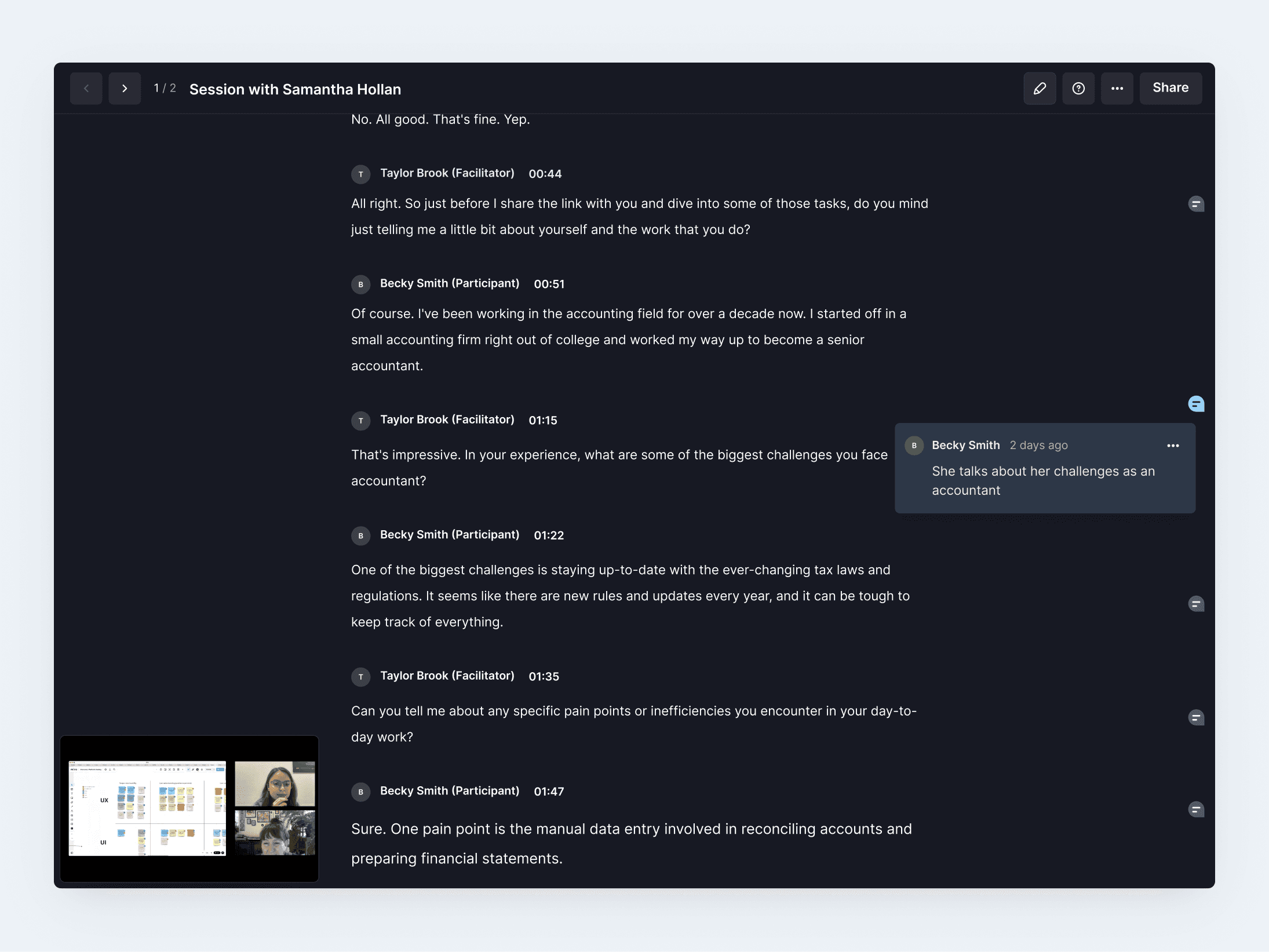
Through customer interviews, I learned that researchers preferred using transcripts rather than video for analysis. This insight led to a transcript-first experience that allowed users to highlight key moments and tag them to group common themes.
I also designed a way for notes taken during calls to appear alongside the transcript, aligned to timestamps. This made it easier for customers to find where each note was taken.

Working with the other squad, I helped design how customers could search for and add relevant highlights to their reports. I created a panel that made it simple to browse and attach highlights as evidence for insights.
Through testing, I found that customers wanted to combine clips to tell a cohesive story. This led to the highlight reel feature, which allowed users to merge and edit clips and embed them directly in reports.


To maintain consistency across teams, I also designed a tag management page where customers could edit, search, merge, and delete tags, as well as add descriptions to give context for others using the same workspace.
By the end of 2023, Askable Plus projects increased by 223% compared to the previous year. This growth was driven by the new Sessions features, which enabled customers to maintain a digital repository of all their research insights.


Throughout the project, I conducted one to three continuous discovery interviews each week. These sessions helped me understand how researchers analyse interviews and make design decisions grounded in evidence.
A significant amount of researchers’ time was spent analysing and synthesising interviews rather than conducting them. The process was highly manual and time-consuming.
Whether using tools like Miro or Dovetail, researchers organised their findings through tags or a codebook to identify emerging themes.
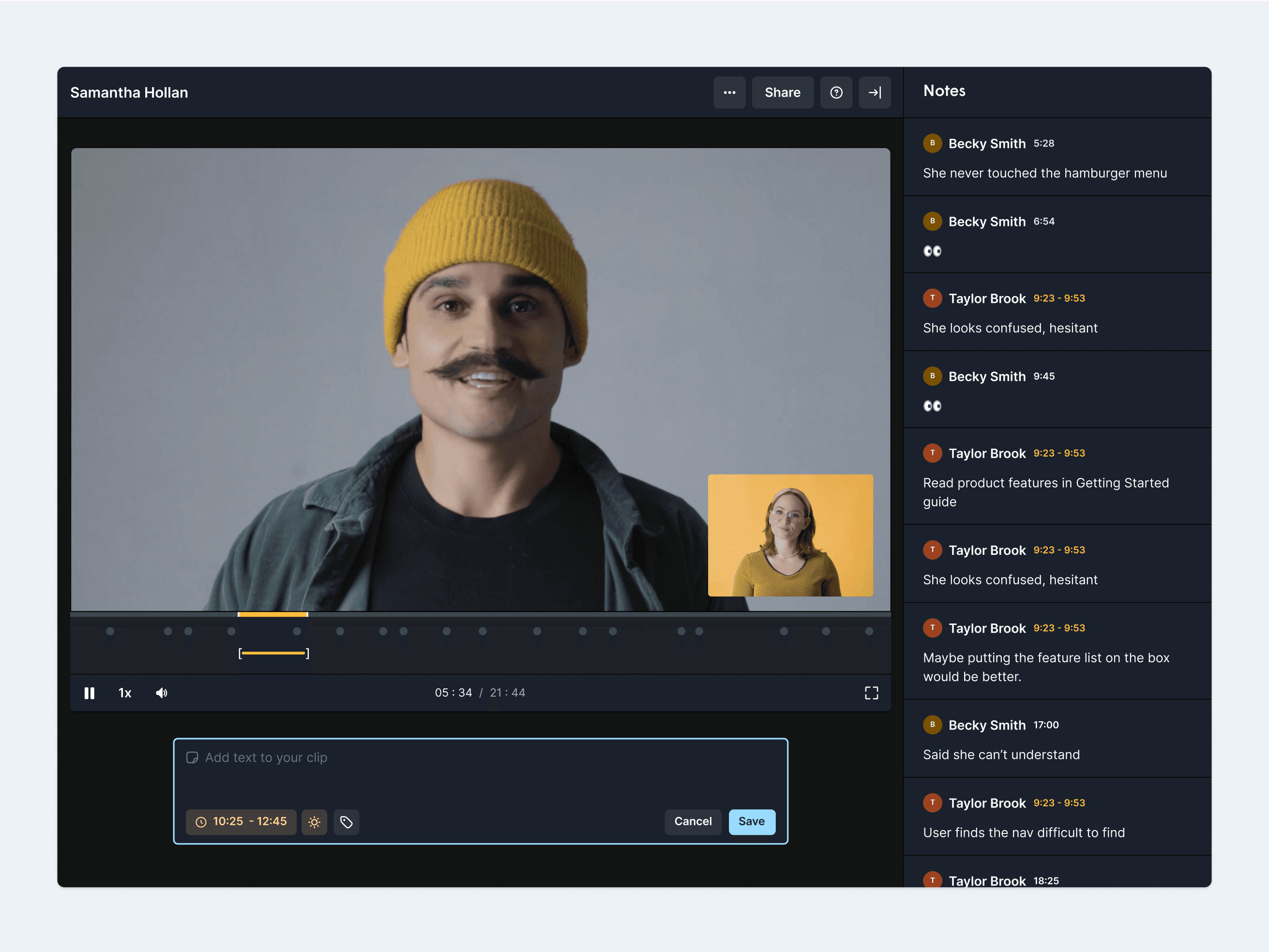
My first concept allowed customers to create highlights directly from video recordings. However, testing revealed that they preferred using transcripts to locate key insights. Based on this feedback, I shifted the focus to a transcript-based design.
I next explored having highlight reels as a standalone feature that customers could edit and share independently. Testing showed that reels were most impactful when connected to insights in reports, so I integrated them into the reporting experience instead.


I also explored using AI to automatically convert notes into highlights. However, testing revealed that customers use notes differently, and this automation could disrupt their process. We decided to keep notes and highlights separate and revisit AI automation in a future release.
Once the direction was clear, I mapped out task flows to cover all potential scenarios and designed detailed Figma prototypes with annotations for developers. These flows ensured all edge cases were considered before build.


Because Askable didn’t have product managers, designers often handled scoping and delivery. I facilitated a story mapping session with developers to define releases and priorities, then created Linear tickets with all design links and documentation. I worked closely with developers throughout implementation, conducting regular reviews to ensure quality and alignment.
The power of discovery
Through this project, I learned the importance of continuous discovery. Regular customer conversations kept the designs grounded in real needs rather than assumptions and helped identify issues early.
Go wide, then narrow your focus
Exploring multiple ideas at the start of the project allowed me to test different directions and refine the best solution. This approach helped surface creative options that might otherwise have been missed.
Be a leader and collaborate
Working without a product manager required me to take ownership of delivery, collaborate closely with developers, and manage scope effectively. This strengthened my leadership and communication skills and improved how I facilitated cross-functional collaboration.